
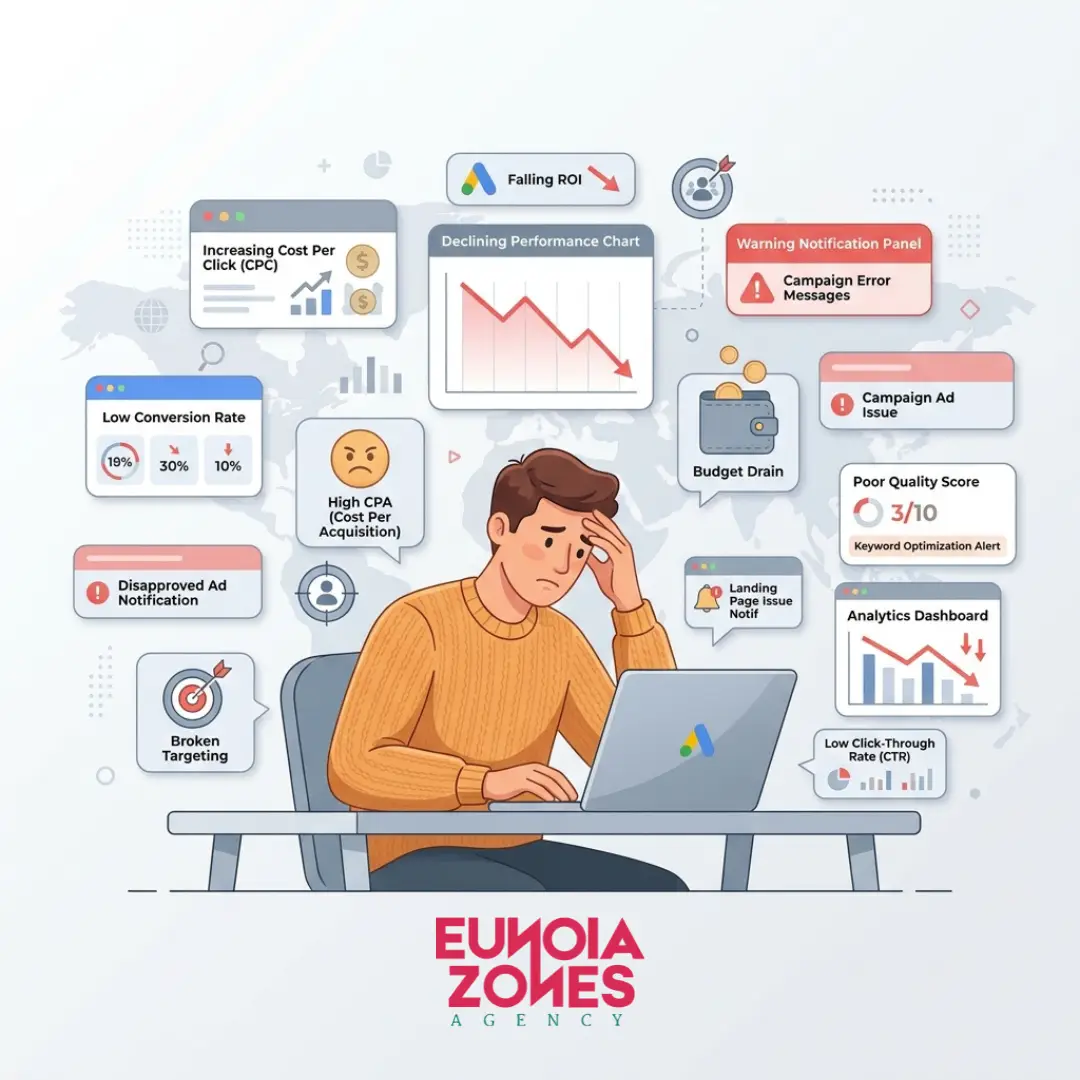
Launching a paid advertising campaign without a flawless execution strategy is one of the fastest ways to burn through a corporate marketing budget. Many businesses launch campaigns on Google, Meta, or TikTok assuming that ad spend automatically translates into market share. However, the modern ad auction ecosystem penalizes inefficiency. To protect your capital and maximize performance, marketing teams must systematically eliminate these six critical errors.
Lack of Clear Campaign Objectives and Strategy
The foundation of a high-performing campaign is an explicit, mathematically aligned objective. A common mistake is using a single campaign to simultaneously drive brand awareness, capture email leads, and secure immediate e-commerce sales.
Because modern ad platform algorithms optimize delivery based strictly on the selected goal, a structural mismatch destabilizes the campaign. For instance, selecting a "Traffic" objective on Meta when your ultimate business goal is "Sales" forces the algorithm to seek out cheap, high-volume clickers who rarely buy, destroying your conversion rate.
Don’t miss this detailed guide: Your Complete Guide to Successful Digital Advertising Campaigns in Egypt
Poor Keyword Research and Targeting
In search engine marketing (SEM), broad and unmonitored targeting leads to catastrophic budget leakage. Advertisers often rely solely on broad-match keywords, mistakenly believing that wider visibility yields more business.
Without aggressive keyword filtering, your ads will trigger for completely irrelevant queries. Failing to maintain a robust Negative Keyword List means a luxury real estate agency might pay high cost-per-click (CPC) rates for searches like "cheap apartments for rent." Targeting requires a strict balance of exact-match and phrase-match keywords alongside precise demographic overlays.
Irrelevant Ad Copy and Landing Pages
A high click-through rate (CTR) means nothing if your website traffic bounces immediately. Budget friction occurs when there is a psychological disconnect between the ad creative and the destination page.
If your ad promises a "40% discount on winter jackets," but the landing page drops the user onto a generic homepage or displays summer footwear, the user leaves within seconds. Google Ads punishes this misalignment by lowering your Quality Score, which automatically drives up your minimum required bid to stay competitive in the auction.
Don’t miss this detailed guide: How to Calculate Your Ad Campaign for Egyptian Businesses
Inadequate Budget Management and Bidding Strategies
Setting and forgetting ad budgets or picking incorrect bidding models regularly tanks ROI. Many brands fall into the trap of using manual bidding without the data capacity to manage it, or conversely, handing total control to automated "Maximize Clicks" strategies without setting a cost-per-click cap (CPC Cap).
Without strict guardrails, automated systems can bid aggressively during competitive holiday seasons or high-volume peak hours, exhausting your entire daily allocation on a handful of hyper-expensive, un-vetted clicks.
Don’t miss this detailed guide: Facebook and Instagram ads for lead generation in Egypt
Neglecting A/B Testing and Optimization
An advertising campaign is an evolving experiment, not a static asset. Advertisers who launch a single ad variant and let it run for months suffer from severe ad fatigue and climbing costs.
Continuous Split Testing (A/B Testing) is mandatory for survival. Brands must relentlessly test competing headlines, creative formats (static vs. video), and calls-to-action (CTAs). By systematically allocating small testing budgets to discover winning combinations, you reduce your overall cost per acquisition (CPA) over time.
Ignoring Mobile Optimization and User Experience
Statistically, over 60% of paid ad traffic originates from mobile devices. Despite this, millions of marketing dollars are wasted driving mobile users to desktop-first websites.
If your landing page loads slowly, features un-clickable forms, or forces users to pinch-and-zoom to read text, they will abandon the conversion funnel instantly. Ad networks monitor this user behavior; high bounce rates and low dwell times signal a poor user experience, leading the platform to de-prioritize your ads and increase your advertising costs. Protect your budget by building a mobile-first, friction-free conversion pathway.
Don’t miss this detailed guide: How to Reduce CPC in Google Ads for Maximum ROI